Costco entering the fertility care conversation has created a lot of attention — and for good reason. Fertility treatment is expensive, emotionally demanding, and often difficult for patients to navigate. Any program that promises lower costs and easier access is naturally going to sound appealing to families who are already facing financial and medical stress.
But when it comes to fertility care, the details matter. A discounted healthcare model may help address cost and access, but it can also create trade-offs in provider choice, personalization, continuity of care, and the overall patient experience.
Before patients view this as “cheap fertility care,” it is important to understand the real fine print behind the model.
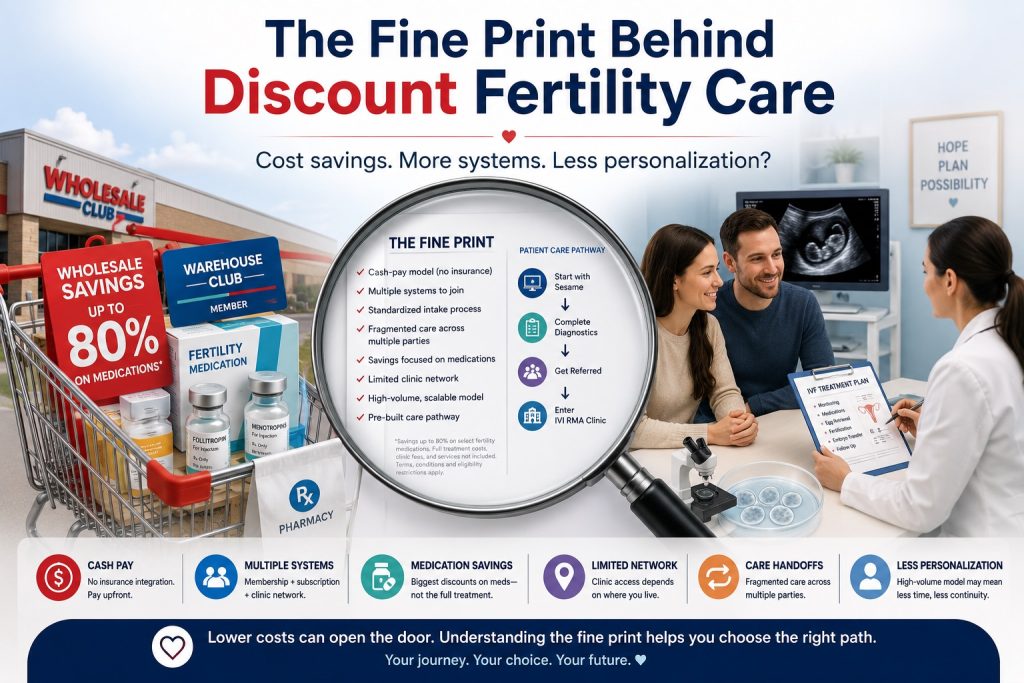
1. It Is a Cash-Pay Model, Not Insurance-Based Care
One of the biggest realities of this type of program is that it operates as a cash-pay healthcare model. That means patients are generally paying upfront out of pocket instead of using direct insurance billing.
For some patients, that may be acceptable. But for others, especially those who already have fertility benefits through an employer or health insurance plan, this could create challenges.
Patients may not be able to directly leverage existing fertility coverage, and any reimbursement may become their responsibility to pursue afterward. That can add paperwork, uncertainty, and financial pressure to an already stressful process.
Translation: This is not necessarily “cheap fertility care.” It is discounted self-pay fertility care.
2. Patients May Need to Be in Multiple Systems at Once
To access the program, patients may need to be connected through several different systems, including a Costco membership, a Sesame subscription, and referral eligibility through the participating fertility clinic network.
That matters because patients are not simply choosing a doctor first. They are entering a structured partnership funnel.
For some people, this may feel convenient. For others, it may feel limiting. If a patient already has a preferred fertility specialist, wants a second opinion, or is looking for a highly specific type of care, the program structure may not offer the flexibility they expect.
Translation: Patients are buying into a network, not simply choosing an individual provider.
3. Everyone Starts with a Standardized Intake Process
Another important detail is the intake process. Patients may be required to begin through a standardized diagnostic and coordination workflow before they reach a fertility specialist.
This can help streamline access, but it may also make the experience feel more like a platform-driven process than a physician-led consultation.
Instead of starting directly with a fertility doctor, patients may first move through centralized screening, intake forms, diagnostics, and triage.
Translation: Patients may not be starting with a fertility expert. They may be starting with a platform.
4. Care May Be Split Across Multiple Parties
Fertility care is already complex. In this model, the patient journey may involve multiple organizations handling different parts of the process.
Sesame may handle intake and coordination. The fertility clinic network may handle actual treatment and procedures. Costco may play a role in medication fulfillment.
That kind of structure can improve access and affordability, but it can also create more handoffs.
In fertility care, handoffs matter. Patients often need frequent communication, medication guidance, cycle monitoring, emotional reassurance, and personalized clinical decision-making. When multiple parties are involved, there is always the potential for confusion or gaps in communication.
Translation: This may be coordinated care, but it is not necessarily continuous care.
5. The Biggest Savings May Be on Medications, Not the Full Treatment Journey
The headline savings can sound significant, especially when fertility medications are involved. However, patients need to understand where the savings are actually coming from.
In many cases, the largest discounts may apply to fertility medications rather than the full cost of IVF, IUI, egg retrieval, lab work, monitoring, or other procedures.
That distinction matters.
Fertility medication costs can be substantial, and savings there are helpful. But IVF cycles can still cost thousands of dollars even after medication discounts. Patients may still be responsible for major treatment expenses, clinic fees, lab costs, anesthesia, genetic testing, monitoring, and other related services.
Translation: The “deal” may be strongest on medications, not the entire fertility journey.
6. Clinic Access May Be Limited by Geography
Patients may also need to be referred into a specific fertility clinic network. That can create geographic limitations.
Not every patient lives near a participating clinic. And fertility treatment is not like a once-a-year doctor visit. Depending on the treatment plan, patients may need several appointments in a short period of time, sometimes multiple visits within a couple of weeks.
For patients who live far from a participating clinic, the real cost may include travel, time off from work, childcare, parking, and added stress.
Translation: Convenience depends heavily on where the patient lives.
7. The Model Is Built for Scale
This type of program appears designed to improve access through faster intake, standardized coordination, and higher patient volume.
That may help more people start the process, but it may also affect how personalized the early experience feels.
Fertility treatment is deeply personal. Patients often come into care after months or years of trying to conceive, dealing with loss, uncertainty, financial anxiety, or emotional exhaustion. A scalable system may improve efficiency, but it may not always provide the level of intimacy and emotional support patients are hoping for.
Translation: The model may be optimized for scale, not individualized care.
8. Patients Are Entering a Pre-Built Pathway
The care journey may follow a fixed structure: start with the platform, complete diagnostics, get referred, and then enter the fertility clinic network.
For patients who want a simple starting point, that could be useful. But for patients who want to choose their doctor first, compare clinics, request a specific specialist, or customize how they begin treatment, the pathway may feel restrictive.
Fertility care is not one-size-fits-all. Patients have different diagnoses, histories, timelines, budgets, cultural needs, emotional needs, and family-building goals.
Translation: This is a guided pipeline, not always a fully tailored starting point.
The Honest Bottom Line
Costco’s fertility care program may help solve a very real problem: cost and access.
That matters. Fertility care is expensive, and many patients are looking for any pathway that makes treatment more affordable.
But patients should also understand the trade-offs.
A lower-cost entry point may come with less personalization, limited provider choice, more fragmented coordination, geographic restrictions, and a care model that feels more standardized than intimate.
For some families, this may be a helpful option. For others, especially those who value a direct doctor-patient relationship, customized treatment planning, and continuity of care, it may not offer the experience they are truly looking for.
The best fertility care is not just about getting a discount. It is about feeling seen, supported, informed, and guided by a team that understands the full emotional and medical weight of the journey.
Before choosing any fertility program, patients should ask the right questions:
- Who will be my actual physician?
- Will I see the same doctor throughout treatment?
- What costs are included and what costs are separate?
- Can I use my insurance or fertility benefits?
- Where will monitoring and procedures happen?
- How many appointments should I expect?
- Who do I contact if I have questions during treatment?
- What happens if my case is more complex?
Cost matters. Access matters. But in fertility care, trust, continuity, and personalization matter too.